

Game developer Michael Klamerus, whose birthday it was on 19 August (happy belated birthday by the way!), issued a challenge on that day to game devs and followers of with blogs to write about an obscure game.
Now, not many games whose soundtracks I enjoyed long ago get to be called “obscure.” Once upon a time game series like Nier and the Mana series may have staked that claim, but that claim was since lost when Nier: Automata became a runaway success, and when many Mana games were being ported to newer systems or, in some cases, remade. But at the time of writing, one series (and by no means the only one), released only on PlayStation 2 and 3, which saw only limited sales globally, still gets to stake the claim of being obscure. Its soundtrack has had a strong bearing on my musicianship and my ability to express emotions through the medium of music.
That series is Ar tonelico. (It has since had two prequel games called Ciel nosurge and Ar nosurge, but those games are equally obscure, and for the purposes of this blog post, I'd like to focus on the Ar tonelico games exclusively.) Let's talk about it.
To begin, when the games' developer Akira Tsuchiya developed those games, he also developed an entirely workable constructed language that served as the primary language for the sung music in the games. That language is Hymmnos. It is so workable, in fact, that Standard Hymmnos is easy to parse and translate into English and Japanese, and that fact alone has caused there to be a decent number of fanmade originals that are written in the Hymmnos language. I'll cover those later.
Hymmnos helped me articulate my emotions well at a time when I otherwise suppressed my emotions due to C-PTSD. I don't say this lightly. In Standard Hymmnos, most sentences begin with what are known as Emotion Sounds. I'll let the Conlang Wiki page explain this for me. Clicking on the image leads directly to the part of that page that describes Emotion Sounds.
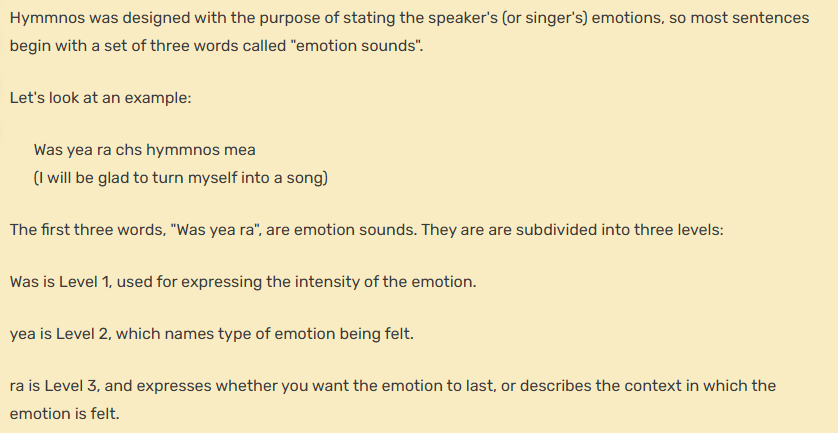
And as you can imagine, there are many Level 1, Level 2, and Level 3 Emotion Sounds to describe a fairly wide array of emotions, intensity, and context. It helped me centre what I was singing and why – a principle that I slowly began to apply to everything else I did musically.
My beginnings as a musician were in both the folk tradition and the liturgical music tradition. I beat the bodhrán for the former, and played pipe organ for the latter. So you can imagine my absolute delight when Ar tonelico, like many JRPGs, channelled both of these influences in its OSTs.
Every game in the series began with a recitative that had a lot of emotion woven into it, describing the setting of the game to some extent, called Singing Hill. Below is a video of my favourite of these, and the sheer amount of lines being sung in this intro should give you an idea of just how much gets expressed with each Hymmnos song.
Ultimately, after all three games were released, a soundtrack album, Ar=Ciel Ar=Dor, was released to tie some narrative loose ends within the games' plot. That album's Singing Hill is a magnificent piece of work, and I have taken many cues from it over the years.
The games may follow the smaller perspectives of characters and their immediate circles of friends, but the events that the games cover are earth-shattering and Biblical in scope.
Ar tonelico: Melody of Elemia, the first game, introduces the world of Ar Ciel, where the entire series takes place. It is technically a futuristic, dystopian scenario as the game's intro describes how people now cling to towers high above the clouds, because the earth's surface has been destroyed beyond human repair due to war. It introduces the players to the continent of Sol Ciel, and then it introduces the race of Reyvateils, artificially constructed humanoid people who wield the power of Song Magic. Song Magic itself can do anything from causing a flame to flicker in the darkness, to materially changing or destroying the world and everything in it, depending on the emotional state and will of the singer (or the person controlling her). In specific, the game focuses on a single vanguard, Lyner Barsett, tasked with protecting a few Reyvateils (Aurica Nestmile and Misha Arsellec Lune come to mind) as they all race against time to stop one of the most powerful Reyvateils in existence, Mir, from breaking free from her prison and destroying the world.
The second game, Ar tonelico II: Melody of Metafalica, takes place in a different continent within Ar Ciel, called Sol Marta, which is crumbling. Given that the surface is uninhabitable, any continent that falls from the clouds spells certain death for all who live in them. Two Reyvateils, Luca and Cloche, who hail from different factions but turn out to be sisters by adoption, follow their factions' paths and eventually work together to sing the long anticipated hymn, EXEC_with_METHOD_METAFALICA/., a hymn previously unsuccessful. If they succeed, they would be able to create a self-sustaining landmass in the clouds, a new utopia for the people of Sol Marta.
The third and final game in the series, Ar tonelico Qoga: Knell of Ar Ciel, deals with considerably more apocalyptic events. The game's events take place in an absolute tyrannical hellhole called Sol Cluster, which was once at war with Sol Ciel and is still seen as a rival and enemy of Sol Ciel's. There are a few people in there who have considerably loftier and nobler ambitions, however: to restore the surface of Ar Ciel so that it can become habitable again, as living in the clouds is not sustainable. Reyvateils Saki, Finnel, and Tyria, and their vanguard Aoto, and the friends they gather around them, race to communicate with entities known as the Wills of the Planet, hoping to convince them of the goodness that humanity has despite its history of war, conflict, hatred, and destruction. The surface of Ar Ciel continues to be uninhabitable due to the rage that it, and the Wills of the Planet, have had for humanity over the millennia. The future of humanity and Reyvateil-kind rests on the protagonists' shoulders.
Having said all this, I like to think that when a language talks about basic concepts, it talks about the passing of the day and the seasons, about activities like farming, hunting or fishing, about myth and legend, and crucially, about spirituality, ritual and religion. Hymmnos does that to a T.
From songs pleading for forgiveness…
to songs talking about the judgment of the Earth…
to exorcism songs that sound quintessentially Japanese…
to legends of in-game heroes Harvestasha and Rhaplanca…
to songs raining down sheer emotionless destruction,
the games have it all. And the games cause global fans of the games to specifically hone in on the games' music, over everything else. While the games themselves receive average scores and reviews (and, true to much Japanese media of the time, are a bit too heavy on the gooner type of suggestive content), we can connect with the characters in many ways, but the aspect of the games whose praises we sing the most is still going to be the music. As I say a lot of the time, Ar tonelico did Nier long before Nier ever did Nier. The first game, Ar tonelico: Melody of Elemia was released in 2006, a whole year before Nier Gestalt and Nier Replicant were, and its soundtrack went to those places which many listeners describe as “sounding like Nier.”
On a small scale, fans of the games' music engage in ludomusicology and linguistic study: we think about these songs in the same way folk songs are written about battles and tragedies and almost any other event imaginable. We think about their implications for listeners and players at large. Some of us who are involved in doujin circles like Stellatram or Aetherhythm write entire histories or alternate universes around the lore of the Ar tonelico games, often communicating these by means of music. It is no surprise to me that one of the people who engaged in making and performing Ar tonelico-inspired fan originals is developer and fellow folk musician and artist Katy Coope (yes, the same one who wrote the book How to Draw Manga). The potential that Hymmnos has to describe entire worlds or images in single songs is immense, and those of us who cross multiple artistic and technical fields understand that well. We don't even need to play the games to imagine what could be, or what could have been. We just need to listen to the music and let the magic happen.
I didn't pursue much Hymmnos writing or composition in the last few years. Most of my input in the language was written before 2021. Other projects took my time and energy. But one particular song I composed still sticks out to me the most, i.e. the intro that I wrote back in 2019 to Aetherhythm's second Hymmnos album, whose title I shorten to Cosmocrystal II Side Red:
Listening back to this feels quaint. In fact, listening even to Stellatram feels quaint. I've grown significantly as a musician, as a composer, as a performer, ever since. My mixing and mastering have improved to the point that I can now reliably mix most things without needing a second opinion. And yet…
I remember the joy that these stories gave me. I remember being so thrilled that I got to beat my favourite drum (of the ones in my possession) for one of the Hymmnos tracks in Cosmocrystal II Side Red. I remember, most of all, the joy that came with expressing my emotions more fully, even if that started in Hymmnos first before finally progressing to English. It's quite staggering to think about it, but the fact of the matter is that part of my ability to express myself both linguistically and musically came from the soundtrack of an obscure game series from the PlayStation 2 days.
And even to this day, regardless of genre, I sing and play my instruments with a very perceptible spiritual bent, which I can partly attribute to being a holdover from my days of listening to the games' OSTs. The soundtrack of the Ar tonelico games has held a sway over me that I can say of no other soundtrack in existence.